Houdini · Vellum · POPs · Pyro · Solaris / Karma
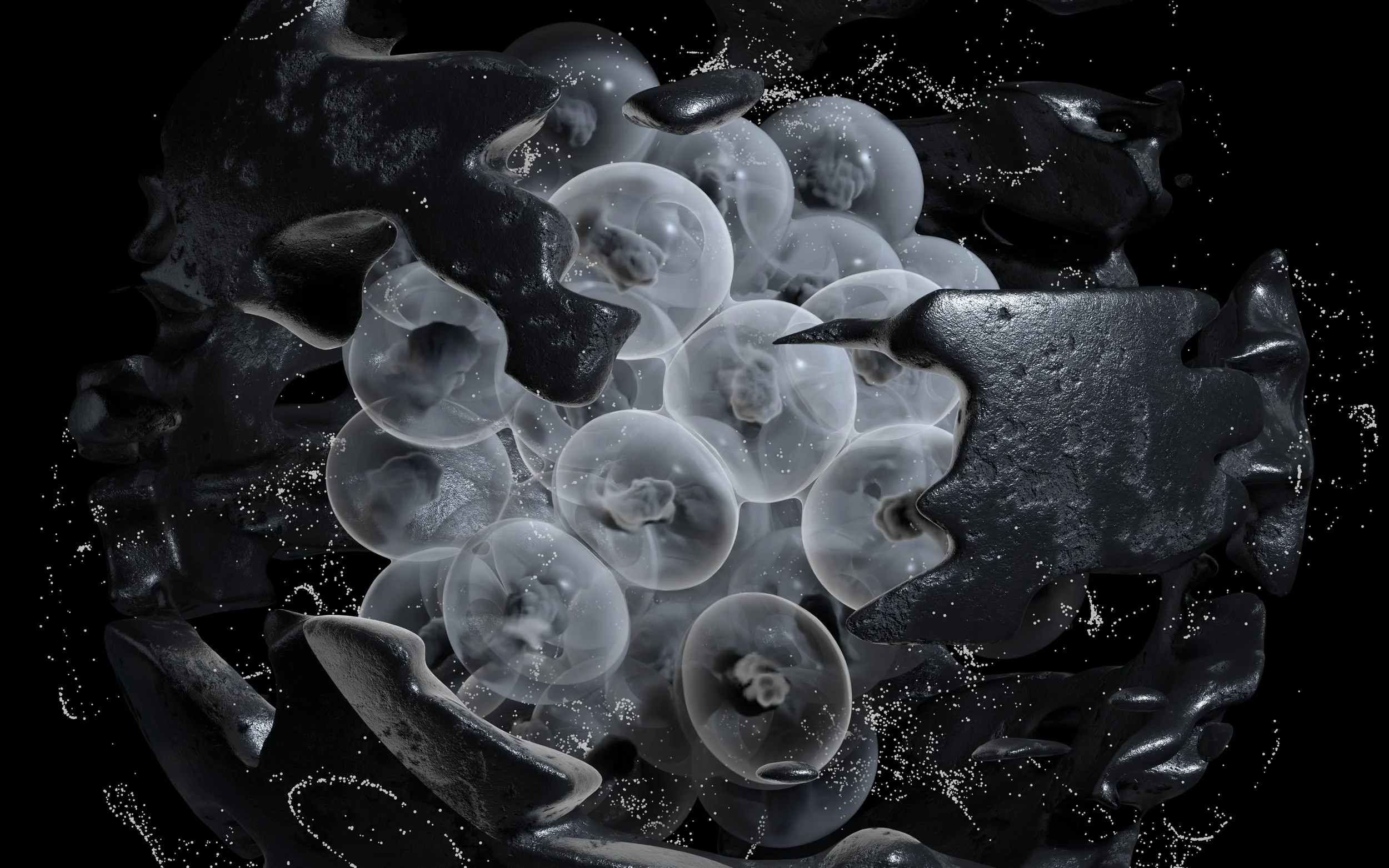
The Computational Landscape explores IVF as a space in which the natural process of creating life takes place within an environment shaped and controlled by humans. The dividing cells represent life itself-fragile, organic, and constantly changing-while the iron shell surrounding them becomes a metaphor for the human world, a structure that protects, organizes, and at the same time limits this process. The particles form a life-supporting environment, somewhere between amniotic fluid, embryonic culture medium, and circulating energy: the conditions that humans are able to create, maintain, and regulate. Yet even a carefully constructed technological environment cannot guarantee the emergence of life, it can only create and support the possibility for life to begin. The smoke inside the cells represents the soul, the part of life that cannot be measured, simulated, or technologically produced. The contrast between the heavy, layered iron structure and the fragile cells emphasizes how carefully human intervention must be approached within the natural process of reproduction. At the core of the work is the idea that technology allows us to influence the conditions in which life begins and develops, but it does not give us complete control over whether life emerges, whether it survives, or what that life will ultimately become.
Solvers
Different solvers control different parts of the system. Vellum and SOP Solvers drive the soft cell behavior and division, POP Networks simulate the particle swarms, and Pyro Solvers generate the smoke volumes inside the cells.
Atmospheric Volumes
The cell cores are turned into density and velocity fields and used as the source for a Pyro simulation. Pyro adds movement and variation to the smoke, while a collision volume keeps it inside the cells. The final smoke is cleaned, cached, and rendered as a volume in Solaris.
Particles Flow
The swarm begins with points scattered around the iron surface. A custom velocity field creates circulating motion, adds animated noise, keeps particles close to the structure, and redirects them around the iron and cells. Within the POP network, Separation, Alignment, and Wander nodes introduce coordinated flocking behavior and organic variation.
Solaris / Karma
The final scene is assembled in Solaris and rendered with Karma. The iron planet geometry is UV-unwrapped across multiple UDIM tiles and textured in Substance Painter. The swarm particles use an emissive MaterialX shader for a bright, energy-like glow, while the cells use view-dependent opacity to create soft translucent membranes that reveal the smoke and inner structures.